State gives districts option to sign with vendors
By Claudia Lauer - The Sun News
Rebecca Koenig/The Sun News
Students board buses at Myrtle Beach Middle School. Horry County schools had a meeting with a vendor about school bus advertising on Jan 18.Advertisements targeting school-age children could be making their way to Horry County school buses.
The S.C. Education Department has given the OK to school districts to start the advertising program under a general contract it signed with SAC Inc., an advertising firm in Warrenville, at the end of November.
"The state has given us the option, and we had a meeting with the advertising vendor that was purely informational," said Teal Britton, Horry County Schools spokeswoman. "There are lots of things that are yet to be determined, in terms of what the financial benefit would be to school districts."
The advertising company's contract with the state specifies that SAC will receive 20 percent of the revenue for each ad; the state, about 80 percent.
"The way the contract works is 80.1 percent of the gross income goes to the state technically because the state owns the property," said Don Tudor, director of the state Education Department's transportation office. "We recognize that these revenues should be appropriately shared with the school district. It is not the state who will be responsible for determining if the advertising is appropriate, and it's the children that make the advertising valuable."
Continued . . .
Friday, January 25, 2008


Wednesday, January 23, 2008
Staff changes not expected over primary
By Mike Cherney - The Sun News
Three members of the Horry County Election Commission said they do not anticipate any staffing changes in the county election office after a programming error disabled voting machines during last Saturday's S.C. Republican presidential primary.
Donna Royson, the deputy director of the S.C. State Election Commission, said Tuesday the state commission will help the county determine exactly what went wrong.
Larry Leagans, Gene Sparks and Deborah Johnson, three members of the county commission, said the commission will meet after the S.C. Democratic presidential primary this Saturday to ensure that similar mistakes do not happen again.
"We're going to try to turn over every stone that needs to be turned over," Leagans said. "I don't see any kind of staffing issues. A mistake was made, and we need to find out why the mistake was made."
During the S.C. Republican primary, State Rep. Tracy Edge, a campaign official with Arizona Sen. John McCain's presidential bid, called for Sandy Martin, the county's election director, to be fired. McCain won the state and the county's votes.
"They need to explain how not changing any staff is going to be sure that no more mistakes are going to be made in the future," Edge said Tuesday. "They need to make a complete report to tell us all exactly what went wrong and why and who failed to do their job."
The five members of the election commission are responsible for hiring and firing the county's election director. Leagans said the commission meets on an as-needed basis.
Continued . . .
Three members of the Horry County Election Commission said they do not anticipate any staffing changes in the county election office after a programming error disabled voting machines during last Saturday's S.C. Republican presidential primary.
Donna Royson, the deputy director of the S.C. State Election Commission, said Tuesday the state commission will help the county determine exactly what went wrong.
Larry Leagans, Gene Sparks and Deborah Johnson, three members of the county commission, said the commission will meet after the S.C. Democratic presidential primary this Saturday to ensure that similar mistakes do not happen again.
"We're going to try to turn over every stone that needs to be turned over," Leagans said. "I don't see any kind of staffing issues. A mistake was made, and we need to find out why the mistake was made."
During the S.C. Republican primary, State Rep. Tracy Edge, a campaign official with Arizona Sen. John McCain's presidential bid, called for Sandy Martin, the county's election director, to be fired. McCain won the state and the county's votes.
"They need to explain how not changing any staff is going to be sure that no more mistakes are going to be made in the future," Edge said Tuesday. "They need to make a complete report to tell us all exactly what went wrong and why and who failed to do their job."
The five members of the election commission are responsible for hiring and firing the county's election director. Leagans said the commission meets on an as-needed basis.
Continued . . .
Sunday, January 20, 2008
SC voting machines not set to zero before voting started
Sun, 01/20/2008 - 00:14 - Wire Services
The voting machines in Horry County, South Carolina were not reset to zero before the first voters came to cast their ballots, the state's Election Commission admitted today.
The Commission stated that the technicians perform a "clear and test" procedure on all machines prior to the machines accepting votes, but in this case, it was not carried out before people arrived at the precincts to vote.
"This resets the test votes recorded on the machine to zero," a press release by the Commission read. "Without performing this measure, the voting system will not allow machines to be opened for voting on election day."
But the Commission blamed the delay on human error, even though Election Systems & Software voting machines used in South Carolina were decertified by the California Secretary of State last year, after the company refused to provide information necessary to review the voting systems, as required by state law.
"Some voters cast paper ballots today in 15-20 precincts because voting machines were not ready to accept votes," the Commission stated. "This issue was due to a human error in preparing the machines for the primary.
The 2008 Primary season has been wracked by allegations of vote fraud stemming from the use of unreliable and easily hackable voting machines belonging to Diebold and ES&S and other vendors.
New Hampshire was forced to carry out a state-wide manual recount after discrepancies emerged between hand counted and machine counted votes.
The voting machines in Horry County, South Carolina were not reset to zero before the first voters came to cast their ballots, the state's Election Commission admitted today.
The Commission stated that the technicians perform a "clear and test" procedure on all machines prior to the machines accepting votes, but in this case, it was not carried out before people arrived at the precincts to vote.
"This resets the test votes recorded on the machine to zero," a press release by the Commission read. "Without performing this measure, the voting system will not allow machines to be opened for voting on election day."
But the Commission blamed the delay on human error, even though Election Systems & Software voting machines used in South Carolina were decertified by the California Secretary of State last year, after the company refused to provide information necessary to review the voting systems, as required by state law.
"Some voters cast paper ballots today in 15-20 precincts because voting machines were not ready to accept votes," the Commission stated. "This issue was due to a human error in preparing the machines for the primary.
The 2008 Primary season has been wracked by allegations of vote fraud stemming from the use of unreliable and easily hackable voting machines belonging to Diebold and ES&S and other vendors.
New Hampshire was forced to carry out a state-wide manual recount after discrepancies emerged between hand counted and machine counted votes.
Voters Turned Away Amongst Complete Chaos in Horry County, South Carolina Primary
By Matthew Jarfi
Make A Difference In Horry County
Chaos would be an understatement in describing the handling of the 2008 Republican Primary Elections in Horry County, South Carolina this past Saturday evening. Horry County is located on the coast of South Carolina and is home to Myrtle Beach. Murphy’s Law was in full effect for the Horry County Elections Commission as things that could go wrong, did go wrong.
A massive 80% of the ESS electronic voting machines were not able to “open up” in Saturday’s primary forcing almost all Horry County precincts to use paper ballots. When precincts opened Saturday morning a majority of the voting machines would not work at all. The Seawinds precinct had reported that the electronic voting machines were down “county wide.”
Paper ballots were issued to Horry County citizens in replacement of the voting machines. The process at the Seawinds precinct was you would take the backup ballot to a table and fill in the bubble next to the candidate that you wished to select in the primary. After filling in the bubble, you would next fold your ballot back and slide it in the manila envelope that you were given and return it to the precinct worker. On one side of the manila envelope you would put your name, address, and your signature. However, this was not protocol in Horry County.
Make A Difference In Horry County has confirmed that some precincts passed out legal pads and simply asked the voters to write their candidate’s name on the 8.5X11 paper. Early reports show that one precinct reportedly turned away voters for seven hours consecutively while at least one other precinct turned away voters but it is currently unknown as to how long. While it is still very early, it is not understood as to why this happened. If one precinct was able to simply ask voters to cast their ballot by writing their candidate down on a piece of paper, than why would another precinct turn away voters?
For those in Horry County who are not a fan of the electronic voting machines, the disabled machines could have been a blessing in disguise. The reason is simply because the South Carolina state Constitution specifically notes that ballots are not allowed be counted in secret. As it has been speculated that this only applies to the paper balloting, there was no back door for Horry County as the paper ballots had to be counted in public.
Voter Fraud?
As Make A Difference In Horry County will investigate the plethora of information that was recorded via video and transcript over the election day, we will also be looking into a potential situation where voter fraud could have taken place. Our reasons for this include the fact that technicians did repair voting machines at precincts where voting machines were down, but it is unknown if the machines were set to a zero count. Additionally, votes were casted on yellow legal pad paper at a particular precinct and later counted in a room filled with stacks of the identical same yellow legal pad paper that was openly used by county officials while those ballots were being counted leaving the possibility open that there could have been suspicious activities to have taken place.
Please stay tuned for the latest information at www.madinhorrycounty.com
Make A Difference In Horry County
Chaos would be an understatement in describing the handling of the 2008 Republican Primary Elections in Horry County, South Carolina this past Saturday evening. Horry County is located on the coast of South Carolina and is home to Myrtle Beach. Murphy’s Law was in full effect for the Horry County Elections Commission as things that could go wrong, did go wrong.
A massive 80% of the ESS electronic voting machines were not able to “open up” in Saturday’s primary forcing almost all Horry County precincts to use paper ballots. When precincts opened Saturday morning a majority of the voting machines would not work at all. The Seawinds precinct had reported that the electronic voting machines were down “county wide.”
Paper ballots were issued to Horry County citizens in replacement of the voting machines. The process at the Seawinds precinct was you would take the backup ballot to a table and fill in the bubble next to the candidate that you wished to select in the primary. After filling in the bubble, you would next fold your ballot back and slide it in the manila envelope that you were given and return it to the precinct worker. On one side of the manila envelope you would put your name, address, and your signature. However, this was not protocol in Horry County.
Make A Difference In Horry County has confirmed that some precincts passed out legal pads and simply asked the voters to write their candidate’s name on the 8.5X11 paper. Early reports show that one precinct reportedly turned away voters for seven hours consecutively while at least one other precinct turned away voters but it is currently unknown as to how long. While it is still very early, it is not understood as to why this happened. If one precinct was able to simply ask voters to cast their ballot by writing their candidate down on a piece of paper, than why would another precinct turn away voters?
For those in Horry County who are not a fan of the electronic voting machines, the disabled machines could have been a blessing in disguise. The reason is simply because the South Carolina state Constitution specifically notes that ballots are not allowed be counted in secret. As it has been speculated that this only applies to the paper balloting, there was no back door for Horry County as the paper ballots had to be counted in public.
Voter Fraud?
As Make A Difference In Horry County will investigate the plethora of information that was recorded via video and transcript over the election day, we will also be looking into a potential situation where voter fraud could have taken place. Our reasons for this include the fact that technicians did repair voting machines at precincts where voting machines were down, but it is unknown if the machines were set to a zero count. Additionally, votes were casted on yellow legal pad paper at a particular precinct and later counted in a room filled with stacks of the identical same yellow legal pad paper that was openly used by county officials while those ballots were being counted leaving the possibility open that there could have been suspicious activities to have taken place.
Please stay tuned for the latest information at www.madinhorrycounty.com
Friday, January 18, 2008
Canada puts U.S., Israel on torture watchlist -CTV
Thu Jan 17, 2008 10:32am EST
OTTAWA, Jan 17 (Reuters) - An official Canadian government document has put both the United States and Israel on a watch list of countries where prisoners run the risk of being tortured, CTV television reported on Thursday.
The revelation is likely to embarrass the minority Conservative government, which is a staunch U.S. ally.
The document mentions the U.S. detention facility at Guantanamo Bay in Cuba where a Canadian man is being held.
CTV said the document was part of a course on torture awareness given to Canadian diplomats to help them determine whether prisoners they visited abroad had been mistreated.
It said the document mentioned U.S. interrogation techniques such as "forced nudity, isolation, and sleep deprivation."
Other countries on the watch list include Syria, China, Iran and Afghanistan, CTV said.
A spokesman for Foreign Minister Maxime Bernier tried to distance Ottawa from the document.
CONTINUED . . .
OTTAWA, Jan 17 (Reuters) - An official Canadian government document has put both the United States and Israel on a watch list of countries where prisoners run the risk of being tortured, CTV television reported on Thursday.
The revelation is likely to embarrass the minority Conservative government, which is a staunch U.S. ally.
The document mentions the U.S. detention facility at Guantanamo Bay in Cuba where a Canadian man is being held.
CTV said the document was part of a course on torture awareness given to Canadian diplomats to help them determine whether prisoners they visited abroad had been mistreated.
It said the document mentioned U.S. interrogation techniques such as "forced nudity, isolation, and sleep deprivation."
Other countries on the watch list include Syria, China, Iran and Afghanistan, CTV said.
A spokesman for Foreign Minister Maxime Bernier tried to distance Ottawa from the document.
CONTINUED . . .
Thursday, January 17, 2008
Bogus Iran story was product of Pentagon spokesman, reporter says
John Byrne
Published: Wednesday January 16, 2008
An American journalist and historian who was the first to break the story of a secret Iranian peace overture to the Bush Administration in 2006 alleges that the latest Pentagon encounter between Iranian ships and a Navy vessel was a deliberate fabrication.
The incident, on Jan. 5 in Strait of Hormuz off the Iranian coast, was originally described as a non-event -- then quickly became one in which Iranian boats threatened to "explode" American ships.
At about 4 am on Monday Jan. 7, the commander of the Fifth Fleet issued a news release on an incident with small Iranian boats. According to reporter Gareth Porter, writing in the Asia Times, "the release reported that the Iranian "small boats" had "maneuvered aggressively in close proximity of [sic] the Hopper [the lead ship of the three-ship convoy]. But it did not suggest that the Iranian boats had threatened the boats or that it had nearly resulted in firing on the Iranian boats."
"On the contrary, the release made the US warships handling of the incident sound almost routine," he adds. "'Following standard procedures,' the release said, "Hopper issued warnings, attempted to establish communications with the small boats and conducted evasive maneuvering.'"
No reference was made to a US ship nearly firing on an Iranian vessel, or suggestions that the US ships would "explode," or white boxes dropped into the water in the path of the US fleet.
This press release, however, went ignored by the media, Porter notes. Instead, the focus turned to CNN's Barbara Starr, who touted allegations that military officials told her Iranian boats were carrying out "threatening maneuvers." CBS soon followed up with a story positing that the Persians had dropped white boxes in the water around the American ships.
CONTINUED . . .
Tuesday, January 15, 2008
'Second Thoughts about Fluoride,' Reports Scientific American
 PR Newswire January 2, 2008
"Some recent studies suggest that over-consumption of fluoride can raise the risks of disorders affecting teeth, bones, the brain and the thyroid gland," reports Scientific American editors (January 2008). "Scientific attitudes toward fluoridation may be starting to shift," writes author Dan Fagin.
"Fluoride, the most consumed drug in the USA, is deliberately added to 2/3 oFf public water supplies theoretically to reduce tooth decay, but with no scientifically-valid evidence proving safety or effectiveness," says lawyer Paul Beeber, President, New York State Coalition Opposed to Fluoridation.
Fagin, award-wining environmental reporter and Director of New York University's Science, Health and Environmental Reporting Program, writes, "There is no universally accepted optimal level for daily intake of fluoride." Some researchers even wonder whether the 1 mg/L added into drinking water is too much, reports Fagin.
After 3 years of scrutinizing hundreds of studies, a National Research Council(NRC) committee "concluded that fluoride can subtly alter endocrine function,especially in the thyroid -- the gland that produces hormones regulating growth and metabolism," reports Fagin.
Fagin quotes John Doull, professor emeritus of pharmacology and toxicology at the University of Kansas Medical Center, who chaired the NRC committee thusly, "The thyroid changes do worry me."
CONTINUED . . .
Some Strand polling places have changed
By Tonya Root - The Sun News
Horry and Georgetown voters should double-check where they will be voting in the upcoming presidential primaries because some locations have changed, according to county election officials.
A few polling locations were temporarily moved for this month's primaries and new ones were added after reorganization, local officials said.
The Republican primary is Saturday, and the Democratic primary is Jan. 26. Polling place changes affect 12 sites in Horry County and one in Georgetown County, according to election officials, but all other voters should be able to vote at their normal polling site, officials said.
Statewide, one-fifth of regular state polling places will be closed as a result of a state law passed last year that gives control of the primaries to the S.C. State Election Commission. About 400 of 2,200 polling places will be merged, said State Election Commission spokesman Chris Whitmire.
Officials said the change was meant to ensure a professionally run election, using state resources and electronic voting machines.
And in an effort to limit costs, the legislature required local election officials to merge some precincts into one polling place.
In Georgetown County, officials moved one polling site because the previous location was no longer available for use, said Billy Altman, chairman of the county's Board of Election and Registration. The location of the Bethel precinct was moved to the Georgetown County Fire Station No. 5, 303 Georgetown Highway, Altman said.
But no sites had to be consolidated, he said.
Horry County officials said they also did not consolidate any polls for the primaries but did change four polling sites for the primaries.
"Last year we did some reorganization of precincts and so we've got several new places voters will be voting at because of that," said Sandy Martin, Horry County's Voters Registration and Election director.
In addition to four temporary sites, Martin said four new precincts were added and four were changed.
--------------------------------------------------------------------------------
POLLING PLACES
HORRY COUNTY
New precincts
Carolina Forest No. 2 at Carolina Forest High School, 700 Gardner Lacy Road, Myrtle Beach
Emerald Forest No. 2 at St. Mary's Missionary Baptist Church, 300 Ronald McNair Blvd., Myrtle Beach
Emerald Forest No. 3 at Ocean Bay Middle School, 905 International Drive, Myrtle Beach
Windy Hill No. 2 at North Myrtle Beach Fire Station No. 5, 4740 Barefoot Resort Blvd., North Myrtle Beach
Temporary voting precincts
Myrtlewood No. 3 at St. John Green Orthodox Church, 3301 U.S. 17 Bypass, Myrtle Beach
Ocean Drive No. 2 at North Myrtle Beach Primary School, 901 11th Ave. N., North Myrtle Beach
Ocean Forest No. 2 and No. 3, both at FUM Church Britton Center, 904 65th Ave. N. next to the YMCA, Myrtle Beach
New permanent voting location changes
Adrian at Academy of Technology and Academics, 5639 U.S. 701 N., Conway
Deerfield at Lakewood Conference Center, 5901 S. Kings Highway, Myrtle Beach
Enterprise at Socastee Library, 141 U.S. 707 Connector Road, Myrtle Beach
Jet Port No. 2 at Myrtle Beach Recreation Center, 800 Gabreski Lane, Myrtle Beach
GEORGETOWN COUNTY
Temporary voting precinct
Bethel at Georgetown County Fire Station No. 5, 303 Georgetown Highway, Georgetown
Horry and Georgetown voters should double-check where they will be voting in the upcoming presidential primaries because some locations have changed, according to county election officials.
A few polling locations were temporarily moved for this month's primaries and new ones were added after reorganization, local officials said.
The Republican primary is Saturday, and the Democratic primary is Jan. 26. Polling place changes affect 12 sites in Horry County and one in Georgetown County, according to election officials, but all other voters should be able to vote at their normal polling site, officials said.
Statewide, one-fifth of regular state polling places will be closed as a result of a state law passed last year that gives control of the primaries to the S.C. State Election Commission. About 400 of 2,200 polling places will be merged, said State Election Commission spokesman Chris Whitmire.
Officials said the change was meant to ensure a professionally run election, using state resources and electronic voting machines.
And in an effort to limit costs, the legislature required local election officials to merge some precincts into one polling place.
In Georgetown County, officials moved one polling site because the previous location was no longer available for use, said Billy Altman, chairman of the county's Board of Election and Registration. The location of the Bethel precinct was moved to the Georgetown County Fire Station No. 5, 303 Georgetown Highway, Altman said.
But no sites had to be consolidated, he said.
Horry County officials said they also did not consolidate any polls for the primaries but did change four polling sites for the primaries.
"Last year we did some reorganization of precincts and so we've got several new places voters will be voting at because of that," said Sandy Martin, Horry County's Voters Registration and Election director.
In addition to four temporary sites, Martin said four new precincts were added and four were changed.
--------------------------------------------------------------------------------
POLLING PLACES
HORRY COUNTY
New precincts
Carolina Forest No. 2 at Carolina Forest High School, 700 Gardner Lacy Road, Myrtle Beach
Emerald Forest No. 2 at St. Mary's Missionary Baptist Church, 300 Ronald McNair Blvd., Myrtle Beach
Emerald Forest No. 3 at Ocean Bay Middle School, 905 International Drive, Myrtle Beach
Windy Hill No. 2 at North Myrtle Beach Fire Station No. 5, 4740 Barefoot Resort Blvd., North Myrtle Beach
Temporary voting precincts
Myrtlewood No. 3 at St. John Green Orthodox Church, 3301 U.S. 17 Bypass, Myrtle Beach
Ocean Drive No. 2 at North Myrtle Beach Primary School, 901 11th Ave. N., North Myrtle Beach
Ocean Forest No. 2 and No. 3, both at FUM Church Britton Center, 904 65th Ave. N. next to the YMCA, Myrtle Beach
New permanent voting location changes
Adrian at Academy of Technology and Academics, 5639 U.S. 701 N., Conway
Deerfield at Lakewood Conference Center, 5901 S. Kings Highway, Myrtle Beach
Enterprise at Socastee Library, 141 U.S. 707 Connector Road, Myrtle Beach
Jet Port No. 2 at Myrtle Beach Recreation Center, 800 Gabreski Lane, Myrtle Beach
GEORGETOWN COUNTY
Temporary voting precinct
Bethel at Georgetown County Fire Station No. 5, 303 Georgetown Highway, Georgetown
Monday, January 14, 2008
Study "Disproving" Mercury-Autism Link Published in Journal with Financial Ties to Vaccine Manufacturers
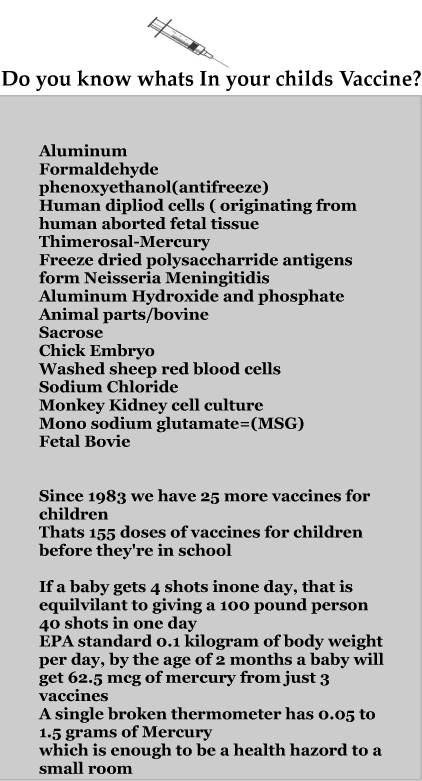
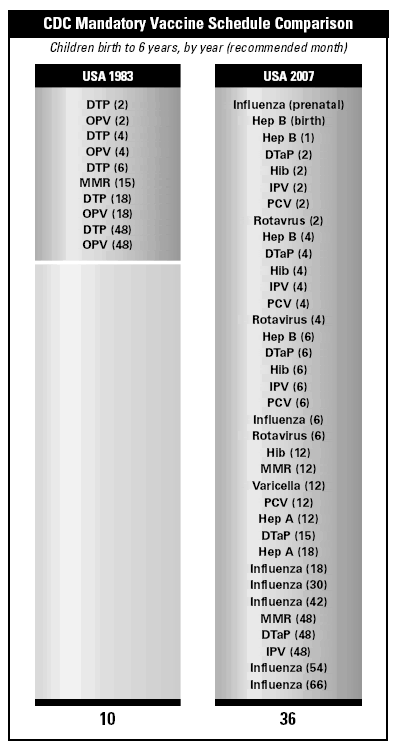
(NewsTarget) While the mainstream press is widely reporting a new study "disproving" any link between autism and mercury-containing thimerosal in vaccines, no one has bothered to point out that the study was published in a medical journal stacked full of ads from the very same drug companies that manufacture and market vaccines. The Journal, the Archives of General Psychiatry, is the pro-drug psychiatric arm of the American Medical Association, a pill-pushing organization tarnished by a history of conspiracy against alternative medicine and the promotion of toxic substances like cigarettes with full-page ads in its flagship publication, JAMA.
From the outset, the fact that this study appears in a pro-drug, pro-psychiatry journal should bring pause to any scientific-minded person. There is obviously a serious conflict of interest here, especially if this study is to be taken as "fact" and applied to public health policy. There also need to be a close look at any financial links between the researchers involved in this study and various vaccine manufacturers, as virtually all pro-drug "science" (if you can call it that) being published these days is influenced by Big Pharma money.
The only truly honest, independent, peer-reviewed medical journal operating today is PLoS Medicine, an open-source journal that takes no money from drug companies. Notice that the autism/mercury link study did not appear in PLoS Medicine? No, it had to be published with a home field advantage in a pro-drug publication that maintains a strong bias in favor of pharmaceuticals and chemicals.
Junk science and faulty conclusions
Aside from these obvious and worrisome conflicts of interest, the conclusions being made about autism and vaccines in the mainstream media are simply not supported by the study. The (distorted) logic we're hearing goes like this:
Yes, vaccines used to contain mercury. And yes, all those little kids were injected with mercury. And yes, autism rates skyrocketed. But then when the mercury was taken out of the vaccines, the autism rates didn't come back down. Therefore, the logic goes, vaccines are safe!
Continued . . .
MB Council to get a public meeting report from DHEC on AVX pollution

By Steve Porter
The Herald
Myrtle Beach—Myrtle Beach City attorney Tom Ellenburg reported to the Myrtle Beach City Council at its regular meeting on Tuesday that the South Carolina Department of Health and Environmental Control would likely appear before the council, in public session, at its next meeting on Jan. 22.
The purpose would be to give the council a full report on the cleaning solution that spilled into the area surrounding the AVX plant, causing concerns about longterm health effects and financial damage to owners of surrounding properties.
A recent public hearing on the problem was held by DHEC for local property owners and residents and the severity of the problem at the time was significantly downgraded, but concerns remain and Ellenburg said he asked a DHEC official at that meeting to consider making a report to city council. That is now apparently in the works.
“Hopefully it will provide more finality than we have heard to date,” said Ellenburg.
He also reported that he and Tom Leath, the city manager, other city officials, and AVX officials and legal counsel had also been meeting and having what he called “frank discussions about the past and future,” of the problem.He said the next phase of the issue would be for remediation options to be discussed, but that those options cannot be determined until the “boundaries of the pollution plume” can be determined by continuing measurements of the area around the plant.
Continued . . .
60 Years of Empire
By SAUL LANDAU
Look at 2008 symbolically! Some 60 years ago, the United States emerged as the world power. Henry Luce formally announced the arrival of "The American Century" even before the country entered World War II. Luce thought the United States should become the world's missionary, spreading Christian values and democracy. US history had woven together a people with noble purpose, Luce argued, and had "the most exciting flag of all the world and of all history," blowing toward the "triumphal purpose of freedom."
Luce, owner of the publishing empire (Time, Life and Fortune), waxed eloquent, calling on all Americans "each to his own measure of capacity, and each in the widest horizon of his vision, to create the first great American Century.
It happened. After World War II, Luce's dream conditions became reality. The United States possessed more than 50% of the world's manufacturing capacity. The powers of Europe and Asia lay in ruins. But politicians and media eschewed the word "empire" to describe the nation that used its dollar as world currency base, set up vast military alliances (NATO, CENTO and SEATO) and, by the early 1950s, had established military bases in scores of other countries and begun to stockpile nuclear weapons.
Continued . . .
Look at 2008 symbolically! Some 60 years ago, the United States emerged as the world power. Henry Luce formally announced the arrival of "The American Century" even before the country entered World War II. Luce thought the United States should become the world's missionary, spreading Christian values and democracy. US history had woven together a people with noble purpose, Luce argued, and had "the most exciting flag of all the world and of all history," blowing toward the "triumphal purpose of freedom."
Luce, owner of the publishing empire (Time, Life and Fortune), waxed eloquent, calling on all Americans "each to his own measure of capacity, and each in the widest horizon of his vision, to create the first great American Century.
It happened. After World War II, Luce's dream conditions became reality. The United States possessed more than 50% of the world's manufacturing capacity. The powers of Europe and Asia lay in ruins. But politicians and media eschewed the word "empire" to describe the nation that used its dollar as world currency base, set up vast military alliances (NATO, CENTO and SEATO) and, by the early 1950s, had established military bases in scores of other countries and begun to stockpile nuclear weapons.
Continued . . .
What Happens to Your Body Within an Hour of Drinking a Coke
 Do you want to be healthy? Drinking soda is bad for your health in so many ways; science can’t even state all the consequences. Here’s what happens in your body when you assault it with a Coke:
Within the first 10 minutes, 10 teaspoons of sugar hit your system. This is 100 percent of your recommended daily intake, and the only reason you don’t vomit as a result of the overwhelming sweetness is because phosphoric acid cuts the flavor.
Within 20 minutes, your blood sugar spikes, and your liver responds to the resulting insulin burst by turning massive amounts of sugar into fat.
Within 40 minutes, caffeine absorption is complete; your pupils dilate, your blood pressure rises, and your livers dumps more sugar into your bloodstream.
Around 45 minutes, your body increases dopamine production, which stimulates the pleasure centers of your brain – a physically identical response to that of heroin, by the way.
After 60 minutes, you’ll start to have a sugar crash.
Sources:
Nutrition Research Center October 24, 2007
Does Animal Testing Help Human Medicine?
33 Facts to be Considered
(1) Less than 2% of human illnesses (1.16%) are ever seen in animals.
(2) According to the former scientific executive of Huntingdon Life Sciences, animal tests and human results agree only "5%-25% of the time".
(3) 95% of drugs passed by animal tests are immediately discarded as useless or dangerous to humans.
(4) At least 50 drugs on the market cause cancer in laboratory animals. They are allowed because it is admitted the animal tests are not relevant.
(5) Procter & Gamble used an artificial musk despite it failing the animal tests, i.e., causing tumours in mice. They said the animal test results were "of little relevance for humans".
(6) When asked if they agreed that animal experiments can be misleading "because of anatomical and physiological differences between animals and humans", 88% of doctors agreed.
(7) Rats are only 37% effective in identifying what causes cancer to humans. Flipping a coin would be more accurate.
(8) Rodents are the animals almost always used in cancer research. They never get carcinomas, the human form of cancer, which affects membranes (e.g lung cancer). Their sarcomas affect bone and connecting tissue: the two cannot be compared.
(9) Up to 90% of animal test results are discarded as they are inapplicable to man.
(10) The results from animal experiments can be altered by factors such as diet and bedding. Bedding has been identified as giving cancer rates of over 90% and almost nil in the same strain of mice at different locations.
Continued . . .
(1) Less than 2% of human illnesses (1.16%) are ever seen in animals.
(2) According to the former scientific executive of Huntingdon Life Sciences, animal tests and human results agree only "5%-25% of the time".
(3) 95% of drugs passed by animal tests are immediately discarded as useless or dangerous to humans.
(4) At least 50 drugs on the market cause cancer in laboratory animals. They are allowed because it is admitted the animal tests are not relevant.
(5) Procter & Gamble used an artificial musk despite it failing the animal tests, i.e., causing tumours in mice. They said the animal test results were "of little relevance for humans".
(6) When asked if they agreed that animal experiments can be misleading "because of anatomical and physiological differences between animals and humans", 88% of doctors agreed.
(7) Rats are only 37% effective in identifying what causes cancer to humans. Flipping a coin would be more accurate.
(8) Rodents are the animals almost always used in cancer research. They never get carcinomas, the human form of cancer, which affects membranes (e.g lung cancer). Their sarcomas affect bone and connecting tissue: the two cannot be compared.
(9) Up to 90% of animal test results are discarded as they are inapplicable to man.
(10) The results from animal experiments can be altered by factors such as diet and bedding. Bedding has been identified as giving cancer rates of over 90% and almost nil in the same strain of mice at different locations.
Continued . . .
Sunday, January 13, 2008
Who Owns Your Candidate? Clinton, Obama & Edwards
by seanarama
Wed Jan 02, 2008 at 11:05:09 AM PST
If lobbyists give a politician enough money, they think they own that politician. And they’re probably right.
Let’s see who’s giving what to who ... and who "owns" which candidates.
After all, if you give a candidate $2,300, and convince 100 of your friends/co-workers/underlings to give him $2,300, that’s $232,300. You might expect significant favors when it comes time to make the next round of laws.
I’m going to show you charts from Opensecrets.org which shows contributions to candidates from selected industries. This gives us an idea which industries might expect favors if certain candidates get elected. One caveat: Corporations only give money if they think it’s going to do them any good. So don’t think the fact that Mike Huckabee gets only a few bucks means he’s a "clean" candidate. It’s just the big corporations think he has little chance of winning.
Also, there are no 100% clean candidates. This isn’t a purity test. It’s a gauge of potential political influence.
BANKS
The banks are in a world of hurt, with bad mortgages on one side and a liquidity crisis (actually a solvency crisis, but that’s a topic for another diary) on the other side. The credit crunch alone – not including all those bad mortgages – could cost the big banks about $250 billion.
The banks will be looking for taxpayers to bail them out. Who are the candidates most likely to do that?

Hillary Clinton and Barack Obama are way, way ahead of the pack on this. The big banks might be right in thinking they’ve bought some serious leverage with these two. John Edwards only comes in eighth. He’s even behind Bill Richardson.
Continued . . .
Wed Jan 02, 2008 at 11:05:09 AM PST
If lobbyists give a politician enough money, they think they own that politician. And they’re probably right.
Let’s see who’s giving what to who ... and who "owns" which candidates.
After all, if you give a candidate $2,300, and convince 100 of your friends/co-workers/underlings to give him $2,300, that’s $232,300. You might expect significant favors when it comes time to make the next round of laws.
I’m going to show you charts from Opensecrets.org which shows contributions to candidates from selected industries. This gives us an idea which industries might expect favors if certain candidates get elected. One caveat: Corporations only give money if they think it’s going to do them any good. So don’t think the fact that Mike Huckabee gets only a few bucks means he’s a "clean" candidate. It’s just the big corporations think he has little chance of winning.
Also, there are no 100% clean candidates. This isn’t a purity test. It’s a gauge of potential political influence.
BANKS
The banks are in a world of hurt, with bad mortgages on one side and a liquidity crisis (actually a solvency crisis, but that’s a topic for another diary) on the other side. The credit crunch alone – not including all those bad mortgages – could cost the big banks about $250 billion.
The banks will be looking for taxpayers to bail them out. Who are the candidates most likely to do that?

Hillary Clinton and Barack Obama are way, way ahead of the pack on this. The big banks might be right in thinking they’ve bought some serious leverage with these two. John Edwards only comes in eighth. He’s even behind Bill Richardson.
Continued . . .
Minuteman speakers blast Graham's immigration stance
Group critical of illegal immigration, effects on U.S. culture and economy
By Robert Morris - The Sun News
A group of vocal foes of illegal immigration continued to marshal support Friday night, recruiting new members, calling for new laws and escalating their criticism of U.S. Sen. Lindsey Graham.
The second meeting of the Horry County chapter of the Minuteman Civil Defense Corps drew about 150 attendees to the Conway High School auditorium, roughly the same as attended the group's first meeting at the Socastee Library in November.
"This fight is not just about illegal immigration," said state Rep. Thad Viers, R-Myrtle Beach, who helped organize the group. "The fight is about preserving American culture and preserving our way of life."
The senator
Almost every speaker Friday mentioned Graham, by name or by an oblique reference to "the senator."
"He's a traitor to his party and a traitor to all South Carolina people," said Robert Warren, an audience member who spoke during the meeting's open forum. "We can't allow him in there again."
Graham earned the ire of such activists through his support of failed legislation that would have strengthened border security while creating a lengthy path to citizenship for illegal immigrants already in the country, dubbed "amnesty" by political opponents.
Scott Farmer, a campaign manager for Graham, declined to discuss the Minuteman group specifically, but defended Graham's position on immigration.
"Senator Graham has always been and continues to be focused on securing the borders. It was his $3 billion amendment that passed the Senate to fund the fence, double border patrol and provide additional detention beds to secure our country," Farmer said.
"I think the senator has been clear about his position, addressing a very difficult and contentious issue based on conservative principles."
Viers said the immigration bill failed because its supporters did not understand the public's wishes.
"We would all be wise to remember the senator up for re-election, where he stands on this issue," Viers said. "I think you'll agree that a change is a-coming."
Continued . . .
By Robert Morris - The Sun News
A group of vocal foes of illegal immigration continued to marshal support Friday night, recruiting new members, calling for new laws and escalating their criticism of U.S. Sen. Lindsey Graham.
The second meeting of the Horry County chapter of the Minuteman Civil Defense Corps drew about 150 attendees to the Conway High School auditorium, roughly the same as attended the group's first meeting at the Socastee Library in November.
"This fight is not just about illegal immigration," said state Rep. Thad Viers, R-Myrtle Beach, who helped organize the group. "The fight is about preserving American culture and preserving our way of life."
The senator
Almost every speaker Friday mentioned Graham, by name or by an oblique reference to "the senator."
"He's a traitor to his party and a traitor to all South Carolina people," said Robert Warren, an audience member who spoke during the meeting's open forum. "We can't allow him in there again."
Graham earned the ire of such activists through his support of failed legislation that would have strengthened border security while creating a lengthy path to citizenship for illegal immigrants already in the country, dubbed "amnesty" by political opponents.
Scott Farmer, a campaign manager for Graham, declined to discuss the Minuteman group specifically, but defended Graham's position on immigration.
"Senator Graham has always been and continues to be focused on securing the borders. It was his $3 billion amendment that passed the Senate to fund the fence, double border patrol and provide additional detention beds to secure our country," Farmer said.
"I think the senator has been clear about his position, addressing a very difficult and contentious issue based on conservative principles."
Viers said the immigration bill failed because its supporters did not understand the public's wishes.
"We would all be wise to remember the senator up for re-election, where he stands on this issue," Viers said. "I think you'll agree that a change is a-coming."
Continued . . .
Bush: ‘We Should Have Bombed’ Aushwitz to Stop the Killing - Ignores Fact His Grandfather Profited from Nazi Slave Labor
Jon Ponder Jan. 11, 2008
George Bush toured the Holocaust memorial in Israel yesterday, and through tears, came up with a telling formulation about what his predecessor, Pres. Franklin Roosevelt, should have done to stop the horror at the German concentration camps:
President George W. Bush had tears in his eyes during an hour-long tour of Israel’s Holocaust memorial and told Secretary of State Condoleezza Rice that the U.S. should have bombed Auschwitz to halt the killing, the memorial’s chairman said.
Bush emerged from a tour of the Yad Vashem memorial today calling it a “sobering reminder” that evil must be resisted, and praising victims for not losing their faith.
Wearing a yarmulke, Bush placed a red-white-and-blue wreath on a stone slab that covers ashes of Holocaust victims taken from six extermination camps. He also lit a torch memorializing the victims.
Bush was visibly moved as he toured the site, said Yad Vashem’s chairman, Avner Shalev.
“Twice, I saw tears well up in his eyes,” Shalev said.
At one point, Bush viewed aerial photos of the Auschwitz camp taken during the war by U.S. forces and called Rice over to discuss why the American government had decided against bombing the site, Shalev said.
“We should have bombed it,” Bush said, according to Shalev.
Continued . . .
George Bush toured the Holocaust memorial in Israel yesterday, and through tears, came up with a telling formulation about what his predecessor, Pres. Franklin Roosevelt, should have done to stop the horror at the German concentration camps:
President George W. Bush had tears in his eyes during an hour-long tour of Israel’s Holocaust memorial and told Secretary of State Condoleezza Rice that the U.S. should have bombed Auschwitz to halt the killing, the memorial’s chairman said.
Bush emerged from a tour of the Yad Vashem memorial today calling it a “sobering reminder” that evil must be resisted, and praising victims for not losing their faith.
Wearing a yarmulke, Bush placed a red-white-and-blue wreath on a stone slab that covers ashes of Holocaust victims taken from six extermination camps. He also lit a torch memorializing the victims.
Bush was visibly moved as he toured the site, said Yad Vashem’s chairman, Avner Shalev.
“Twice, I saw tears well up in his eyes,” Shalev said.
At one point, Bush viewed aerial photos of the Auschwitz camp taken during the war by U.S. forces and called Rice over to discuss why the American government had decided against bombing the site, Shalev said.
“We should have bombed it,” Bush said, according to Shalev.
Continued . . .
Inside the Martial Law Act of 2006
James Bovard
Counterpunch
January 9, 2008
Martial law is perhaps the ultimate stomping of freedom. And yet, on September 30, 2006, Congress passed a provision in a 591-page bill that will make it easy for President Bush to impose martial law in response to a terrorist "incident." It also empowers him to effectively declare martial law in response to what he or other federal officials label a shortfall of "public order" — whatever that means.
It took only a few paragraphs in a $500 billion, 591-page bill to raze one of the most important limits on federal power. Congress passed the Insurrection Act in 1807 to severely restrict the president’s ability to deploy the military within the United States. The Posse Comitatus Act of 1878 tightened those restrictions, imposing a two-year prison sentence on anyone who used the military within the United States without the express permission of Congress. (This act was passed after the depredations of the U.S. military throughout the Southern states during Reconstruction.)
But there is a loophole: Posse Comitatus is waived if the president invokes the Insurrection Act.
The Insurrection Act and Posse Comitatus Act aim to deter dictatorship while permitting a narrow window for the president to temporarily use the military at home. But the 2006 reforms basically threw any concern about dictatorial abuses out the window.
Section 1076 of the Defense Authorization Act of 2006 changed the name of the key provision in the statute book from "Insurrection Act" to "Enforcement of the Laws to Restore Public Order Act." The Insurrection Act of 1807 stated that the president could deploy troops within the United States only "to suppress, in a State, any insurrection, domestic violence, unlawful combination, or conspiracy." The new law expands the list of pretexts to include "natural disaster, epidemic, or other serious public health emergency, terrorist attack or incident, or other condition" — and such a "condition" is not defined or limited.
One might think that given the experience with the USA PATRIOT Act and manyother abuses of power, Congress would be leery about giving this president his biggest blank check yet to suspend the Constitution. But that would be naive.
Continued . . .
Counterpunch
January 9, 2008
Martial law is perhaps the ultimate stomping of freedom. And yet, on September 30, 2006, Congress passed a provision in a 591-page bill that will make it easy for President Bush to impose martial law in response to a terrorist "incident." It also empowers him to effectively declare martial law in response to what he or other federal officials label a shortfall of "public order" — whatever that means.
It took only a few paragraphs in a $500 billion, 591-page bill to raze one of the most important limits on federal power. Congress passed the Insurrection Act in 1807 to severely restrict the president’s ability to deploy the military within the United States. The Posse Comitatus Act of 1878 tightened those restrictions, imposing a two-year prison sentence on anyone who used the military within the United States without the express permission of Congress. (This act was passed after the depredations of the U.S. military throughout the Southern states during Reconstruction.)
But there is a loophole: Posse Comitatus is waived if the president invokes the Insurrection Act.
The Insurrection Act and Posse Comitatus Act aim to deter dictatorship while permitting a narrow window for the president to temporarily use the military at home. But the 2006 reforms basically threw any concern about dictatorial abuses out the window.
Section 1076 of the Defense Authorization Act of 2006 changed the name of the key provision in the statute book from "Insurrection Act" to "Enforcement of the Laws to Restore Public Order Act." The Insurrection Act of 1807 stated that the president could deploy troops within the United States only "to suppress, in a State, any insurrection, domestic violence, unlawful combination, or conspiracy." The new law expands the list of pretexts to include "natural disaster, epidemic, or other serious public health emergency, terrorist attack or incident, or other condition" — and such a "condition" is not defined or limited.
One might think that given the experience with the USA PATRIOT Act and manyother abuses of power, Congress would be leery about giving this president his biggest blank check yet to suspend the Constitution. But that would be naive.
Continued . . .
This is What A Police State Looks Like
This is What A Police State Looks Like
This is a breakdown of what happened in Seattle when the Police attacked the crowd with chemical weapons without provocation or reason. They use video footage from the Police cameras themselves to demonstrate the point that the Police indeed incite riots and ATTACK crowds for no reason.
This is a breakdown of what happened in Seattle when the Police attacked the crowd with chemical weapons without provocation or reason. They use video footage from the Police cameras themselves to demonstrate the point that the Police indeed incite riots and ATTACK crowds for no reason.
Subscribe to:
Posts (Atom)
